Indications
① Applicable situations
• Patients unsuitable for surgery or seeking minimally invasive treatment: For elderly, frail, or patients with insufficient cardiopulmonary reserve, seed implantation is usually performed under imaging guidance, with a small incision and relatively faster recovery.
• Tumors in complex locations requiring preservation of critical structures: For lesions adjacent to major blood vessels, nerves, or vital organs, where surgical resection carries high risk, local treatment can be performed while maximizing functional preservation.
• Recurrent or residual lesions after radiotherapy/chemotherapy or external beam radiation: For local recurrence after prior treatment, or when external radiation efficacy is limited or dosage-restricted, seed implantation can serve as a local supplemental or salvage therapy.
• Patients with mid- to late-stage tumors requiring enhanced local control: In the context of systemic therapy, for lesions causing significant symptoms or heavy local tumor burden, seed implantation can relieve symptoms, improve quality of life, and create conditions for subsequent treatments.
② Common indications
Iodine-125 seed implantation has broad clinical applicability for local control of solid tumors across multiple systems. Commonly treated tumors include: prostate cancer; lung cancer and thoracic tumors (including some lung metastases, chest wall/mediastinal lesions); liver cancer and liver metastases; pancreatic cancer; cholangiocarcinoma and other abdominal tumors; head and neck tumors (e.g., nasopharyngeal, oral, maxillofacial lesions); intraorbital tumors; brain tumors; bone and soft tissue tumors; paraspinal and vertebral lesions; pelvic tumors and recurrent pelvic tumors (including gynecologic lesions); kidney and adrenal tumors.
Core Advantages
① Precise "High-Dose, Local" Radiotherapy
Seeds are directly implanted into the tumor, delivering a radiation dose far higher than that received by surrounding normal tissue. The dose rapidly decreases with distance, helping to control the lesion while minimizing exposure to adjacent organs.
② Small effective radius, minimal exposure to surrounding tissue
Iodine-125 seeds have an effective radiation range of approximately 1.7--2.0 cm. Through careful target design, highly conformal irradiation can be achieved, resulting in relatively lower doses to non-target areas and generally better overall tolerance.
③ Not affected by blood flow "heat-sink effect," enabling highly conformal target design
As a radiotherapy modality rather than thermal ablation, efficacy does not depend on heating or cooling and is not influenced by heat carried away by blood flow. Pre- and intraoperative planning allows highly conformal source placement that closely matches tumor morphology, particularly useful for complex or highly vascularized lesions.
④ Continuous, low-dose-rate irradiation covering tumor cells in different proliferation stages
The seeds have a half-life of approximately 59.4 days, with effective cytotoxic activity lasting about 180 days, representing continuous low-dose-rate radiotherapy. Compared to single-session external irradiation, this approach aligns better with tumor cell cycle characteristics, suppressing tumor cell division and regrowth over an extended period.
⑤ Miniature titanium alloy sealed radioactive sources with good tissue compatibility and stability
Seeds are sealed in titanium alloy tubes (approximately 0.8 × 4.5 mm). The titanium alloy casing is biocompatible, facilitating placement and long-term retention, while the sealed design reduces the risk of radioactive leakage.
⑥ Provides "local reinforcement" for advanced or recurrent patients
For lesions unsuitable for surgery, restricted by external beam dose, or inadequately controlled by systemic therapy, seed implantation serves as local dose supplementation or salvage therapy. It can relieve symptoms, control local progression, and be combined with interventional or systemic treatment strategies to create favorable conditions for subsequent comprehensive therapy.
Why Choose Jinshazhou Hospital?
① Personalized Source Placement: "Custom Layout" Based on TPS 3D Planning
Our hospital emphasizes a standardized pathway of "plan first, implement second, verify last" for Iodine-125 seed implantation. Using the TPS 3D treatment planning system and CT imaging, the team contours the target area and designs the dose distribution, taking into account tumor volume, shape, and distance to surrounding critical structures. The number of seeds, needle paths, and spacing are calculated to ensure dose distribution matches the target as closely as possible, achieving high conformity.
② Intraoperative Real-Time Verification: Gaps Can Be Corrected Immediately
During the procedure, intraoperative planning verification and quality control are emphasized. If imaging or dose evaluation indicates insufficient local coverage, additional seeds can be implanted safely to optimize distribution, improving completeness and consistency of target coverage, ensuring the treatment transitions smoothly from "design" to "implementation."
③ Multidisciplinary Collaboration: Integrating Seed Implantation into the Overall Treatment Plan
For patients with advanced or recurrent tumors, the hospital uses MDT evaluation to integrate seed implantation with interventional therapy, systemic therapy, radiotherapy, and supportive care. This approach controls local lesions while addressing symptom relief and quality of life, making seed implantation an essential component of comprehensive treatment.
Technical Definition
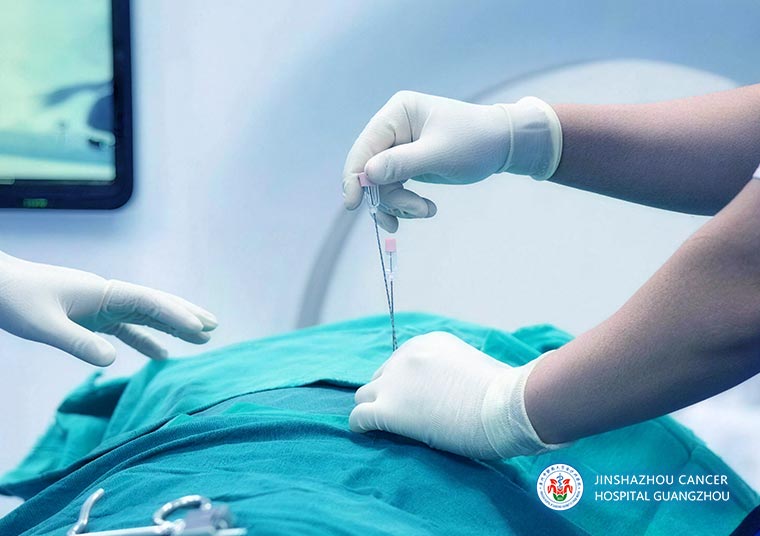
Iodine-125 seed implantation is a form of brachytherapy (internal radiation therapy). Under CT, ultrasound, or other imaging guidance, a TPS treatment planning system is used to design a three-dimensional dose distribution. Through percutaneous puncture, sealed radioactive sources---Iodine-125 seeds---are implanted into the tumor or its infiltrative areas according to the treatment plan. This provides continuous, low-dose-rate local irradiation to the target area, achieving precise local tumor control while minimizing radiation exposure to surrounding normal tissues.
Mechanism of Action / Working Principle
Iodine-125 seeds continuously decay in the body, emitting low-energy γ-rays (approximately 27--35 keV), with an effective range of about 1.5--2.0 cm. Because the seeds are directly implanted into the tumor, the target area receives a higher local radiation dose, while the dose rapidly decreases with distance, helping to minimize exposure to surrounding tissues.
The biological effects include: the direct effect, in which radiation causes DNA strand breaks in tumor cells, inhibiting mitosis and cell proliferation; and the indirect effect, in which radiation interacts with tissue water molecules to generate free radicals (such as H⁺, OH⁻), further damaging DNA and inducing cell death. The continuous low-dose-rate irradiation from the seeds covers tumor cells at different stages of proliferation over an extended period, enhancing local tumor control.
Treatment Procedure
① Imaging Examination and Lesion Localization
Perform a CT scan to determine the tumor's location, size, and relationship with surrounding tissues, providing three-dimensional data for treatment planning.
② TPS Treatment Plan Design (Preoperative Planning)
Outline the gross tumor volume (GTV) in the TPS treatment planning system. Based on lesion characteristics, prescribe the dose (PD), design the puncture paths, needle distribution, number of seeds, and spatial arrangement to match the planned dose distribution with the target area, achieving high conformity.
③ CT-Guided Puncture Point Localization and Needle Placement
Under CT (or other imaging) guidance, locate the puncture point and insert the puncture needle percutaneously into the tumor target area, arranging the needle paths and insertion depth according to the plan.
④ Seed Implantation (Performed Step by Step per Plan)
Using the implantation device, release seeds at different depths along each needle path. Complete seed implantation for all needle paths so that the radiation dose distribution aligns closely with the tumor target area.
⑤ Intraoperative Real-Time Verification and Supplementation (Plan Verification)
Perform real-time plan verification during the procedure to assess whether the dose distribution adequately covers the target. If local dose-deficient areas are detected, supplement seeds as needed to optimize coverage and conformity.
⑥ Completion of Procedure and Wound Management
After implantation, withdraw the needles. Disinfect, apply pressure, or bandage the puncture site and provide necessary observation.
⑦ Postoperative Evaluation and Follow-Up
Combine postoperative imaging review with dose evaluation to confirm seed distribution and target coverage. Follow the physician's instructions for follow-up, assessing local control and potential adverse reactions, and guide subsequent comprehensive treatment planning.
Safety and Precautions
① Follow basic protection principles during and after the procedure
Manage according to the "distance--time--key population" principle as instructed by the physician, avoiding unnecessary prolonged or close contact.
② Limit contact with children, pregnant, or breastfeeding individuals
Follow medical advice to appropriately reduce prolonged close contact with these populations.
③ Short-term activity restrictions and puncture site care
Avoid running, jumping, heavy lifting, or intense twisting in the short term to prevent bleeding or discomfort at the puncture site. Keep the puncture site clean and dry, change dressings as instructed, and seek medical attention if redness, swelling, heat, pain, persistent bleeding, or fever occurs.
Frequently Asked Questions
① Do the particles need to be removed?
Generally, no. The particles' radioactivity gradually decays, and their casing is sealed titanium alloy, so they can usually remain in the body long-term without surgical removal.
② Is iodine-125 seed implantation performed under local or general anesthesia?
In most cases, local anesthesia is used. The need for deeper anesthesia depends on the tumor location, complexity of the puncture path, procedure duration, and patient tolerance, with the final decision made according to anesthesiology assessment and the attending physician's plan.
③ How long does it take to recover after treatment?
After the procedure, short-term observation is usually required, along with puncture site care and activity management as instructed. Most patients can resume light daily activities relatively quickly, but should avoid strenuous exercise and heavy physical labor in the short term. Imaging follow-ups are performed to assess particle position and local response. Recovery pace and hospitalization requirements depend on tumor location, treatment extent, and individual condition, following physician guidance.
Typical Cases
① Case 1:
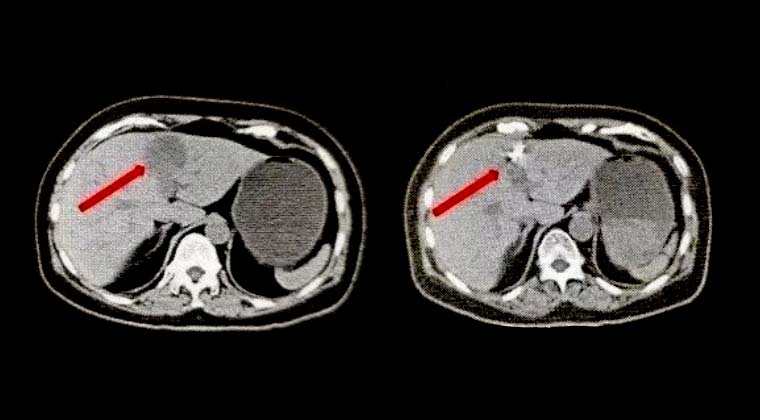
Patient: Female, 58 years old, cervical squamous cell carcinoma
The patient experienced postoperative recurrence and visited our hospital for treatment approximately half a month after her last chemotherapy.
CT examination revealed secondary malignant lesions in the liver.
After consultation and discussion by oncology specialists, it was decided to perform iodine-125 seed implantation for the hepatic metastatic lesions.
Left image: Preoperative CT
Right image: One month post-treatment, follow-up CT (lesion clearly resolved)
② Case 2:
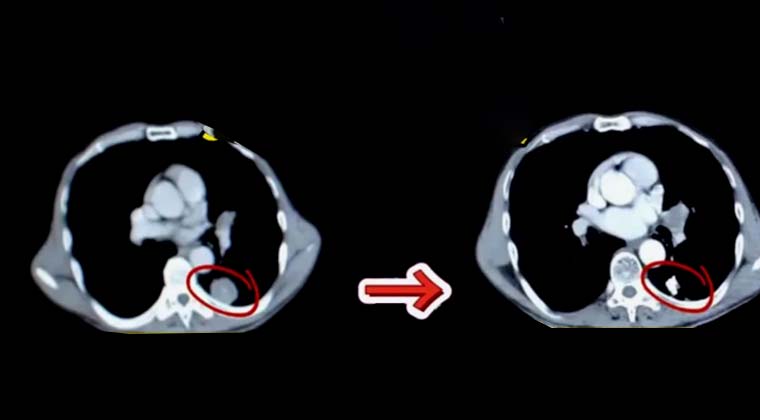
Patient, 75 years old, lung cancer
Under evaluation, underwent I-125 seed implantation under image guidance.
Pre-treatment lesion approximately 4×4 cm.
Follow-up at ~50 days post-treatment shows significant reduction of the lesion, with no measurable tumor in the original area.
75-year-old patient with lung cancer, complete tumor disappearance 50 days after I-125 seed implantation.
Pre-treatment: 4×4 cm tumor
Post-treatment: Complete disappearance of the tumor
③ Case 3:
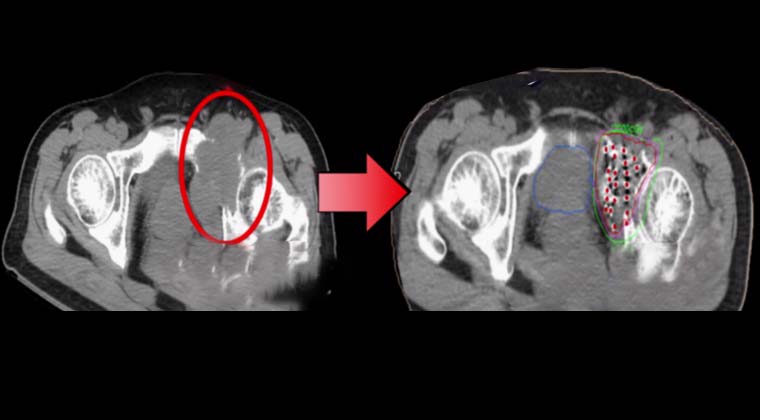
Patient with prostate cancer with bone metastases. After I-125 seed implantation, the bone tumor showed significant reduction.
Prostate cancer with bone metastases
Before treatment
After treatment
After particle implantation, the bone tumor showed significant shrinkage
 + 86 17688273501
 Address
 Email Form
 Language
 English

 Hotline Phone+ 86 17688273501

 Back to Menu