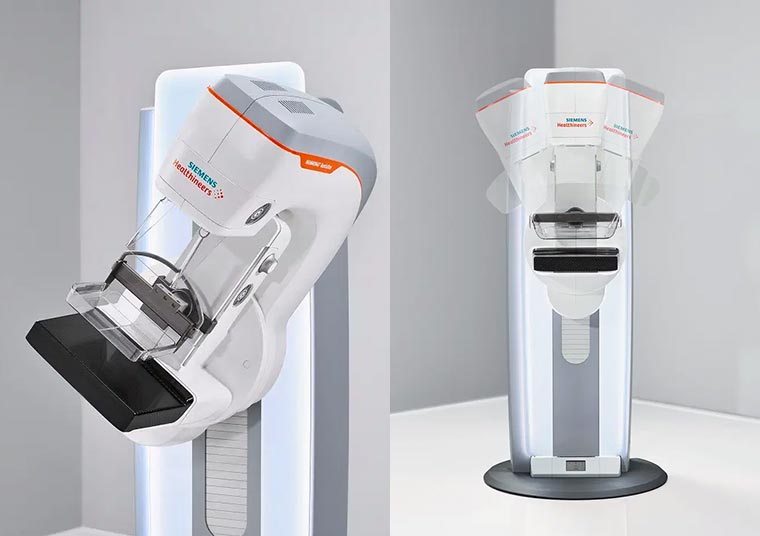
Siemens high-end digital mammography X-ray system
MAMMOMAT Revelation
Mammography is the preferred imaging method for breast diseases and is one of the most effective examination methods for the early detection and diagnosis of breast cancer, capable of detecting early-stage breast cancer that is negative on clinical palpation.
To meet the needs of a wide range of patients, Jinshazhou Hospital of Guangzhou University of Chinese Medicine has recently introduced the Siemens high-end mammography system --- MAMMOMAT Revelation, which will soon be officially put into use in the Department of Imaging of our hospital. The introduced Siemens high-end mammography system is currently one of the top-configured breast X-ray examination devices in China.
With the commissioning of the fully digital MAMMOMAT Revelation at Jinshazhou Hospital of Guangzhou University of Chinese Medicine, more comprehensive and high-quality services will be provided for patients' physical and mental health, and it also marks that the hospital's breast examination technology and diagnostic level have reached a new stage.
Features of the Siemens high-end digital mammography X-ray system:
I. Precise screening and diagnosis
1. 50° ultra-wide-angle tomosynthesis
It compensates for the limitations of traditional two-dimensional mammography by adopting a unique 50° wide-angle scanning technology, with 25 ultra-low-dose exposures. Through excellent Z-axis resolution, it reduces the effect of tissue overlap and effectively improves the sensitivity and specificity of breast examinations. Tomosynthesis images facilitate the detection of low-contrast lesions and enable better identification of subtle breast lesions and structural distortions. In addition, through the acquisition of three-dimensional data, the distribution of microcalcifications, as well as the size, shape, and margin characteristics of masses, can be clearly displayed, which is conducive to the early detection of breast cancer.
【IMG3】
【IMG4】
Excellent Z-axis resolution
Acquires more information and reduces the effect of tissue overlap
Ultrasound image
15°small-angle tomosynthesis
140 μm resolution
Two suspicious lesions
50°ultra-wide-angle tomosynthesis
85 μm resolution
Invasive ductal carcinoma, grade 2
Tissue overlap
2. 50° ultra-wide-angle stereoscopic Tomo
Adopts Insight 2D and 3D stereoscopic tomosynthesis technology to reduce radiation dose, simplify the examination process, and enable multi-angle rotational observation of the breast, thereby improving diagnostic accuracy.
【IMG5】
Display of calcification clusters: A shows standard DBT reconstructed tomographic images; B shows Insight 2D images
C and D show Insight 3D images, with D displaying magnified images from multiple angles
II. TiCEM titanium dual-energy contrast-enhanced imaging
Based on the differences in contrast agent response between normal tissue and tumor tissue, it can display iodine uptake curves of the contrast agent to indicate tumor tissue, improving the diagnosis of benign and malignant tumors.
【IMG6】
Low-energy images show one suspicious mass (arrow) and three fibroadenomas (arrows), with one showing calcification. In TiCEM images, fibroadenomas show no enhancement, while the suspicious mass shows enhancement; pathology confirms IDC combined with DCIS
III. Wide-angle tomosynthesis integrated precise biopsy
The advantages of tomosynthesis extend to the puncture stage, providing more precise positioning and more convenient operation. Under the guidance of three-dimensional tomosynthesis images, the puncture guidewire can be positioned at micro-lesions or calcifications in the breast, enabling one-click positioning and rapid sampling.
IV. Digital imaging-guided galactography
Applicable to the diagnosis of lesions such as intraductal occupying lesions, ductal dilatation, and nipple discharge.
V. Comprehensive care for women
1. PRIME low-dose technology is adopted, effectively reducing radiation dose by 30% without affecting image quality
2. The intelligent compression system OpComp and the flexible compression paddle SoftComp are adopted, greatly improving patient comfort during mammography examination.
【IMG7】
Comprehensive patient care solution
Proprietary PRIME technology reduces dose by 30%
More than 70,000 cases demonstrate:
PRIME mode
Does not affect image quality
-30% Dose
Non-PRIME mode (68 mAs)
PRIME mode (45 mAs)
【IMG8】
Intelligent compression system OpComp
• Automatically stops compression upon reaching the optimal pressure point
• Ensures image quality while improving patient comfort
Flexible compression paddle SoftComp
• Curved edge design
• Patient-oriented, flexible compression
 + 86 17688273501
 Address
 Email Form
 Language
 English

 Hotline Phone+ 86 17688273501

 Back to Menu