Indications
In the treatment of brain tumors, laser ablation technology is mainly used for lesions located in deep regions or those associated with a high surgical risk, and is particularly suitable for cases that are difficult to manage with conventional craniotomy. Common indications include:
1. Gliomas
(such as low-grade or certain high-grade gliomas)
2. Recurrent brain tumors
3. Tumors located in functional areas or deep structures
4. Benign and malignant brain tumors
5. Patients who are not suitable for or cannot tolerate craniotomy
In addition, for lesions with relatively small tumor size and relatively clear boundaries, laser ablation can also be used as an important minimally invasive treatment option.
Core Advantages
1. Minimally invasive precision
Through imaging equipment (CT or ultrasound), the tumor is precisely localized, and an ultra-thin laser fiber is used to enter the tumor tissue, resulting in minimal damage to the surrounding normal tissues.
2. Efficient tumor inactivation
The high temperature generated by the laser can rapidly destroy the structure of tumor cells, leading to coagulative necrosis of tumor tissue.
3. Rapid recovery
The incision is only needle-sized, and most patients experience rapid postoperative recovery and a short hospital stay.
4. Repeatable treatment
If tumor recurrence occurs or new lesions appear, treatment can be performed again.
5. Fewer complications
Compared with traditional surgery, there is less bleeding and a lower risk of infection.
Why choose Jinshazhou Hospital of Guangzhou University of Chinese Medicine?
1. Multidisciplinary team (MDT) approach
The hospital integrates experts from oncology, imaging, and interventional departments to develop individualized treatment plans for patients.
2. Advanced equipment and technological platform
Internationally advanced laser ablation systems and high-precision imaging guidance equipment are introduced to improve treatment accuracy.
3. Extensive clinical experience
The expert team has rich experience in the field of minimally invasive tumor treatment and has provided individualized treatment for numerous patients.
4. Integration of traditional Chinese and Western medicine
Relying on the academic strengths of Guangzhou University of Chinese Medicine, traditional Chinese medicine regulation is combined with minimally invasive treatment to improve overall rehabilitation outcomes.
5. Comprehensive rehabilitation management system
From diagnosis and treatment to postoperative rehabilitation and follow-up, full-process medical management services are provided.
Technical Definition
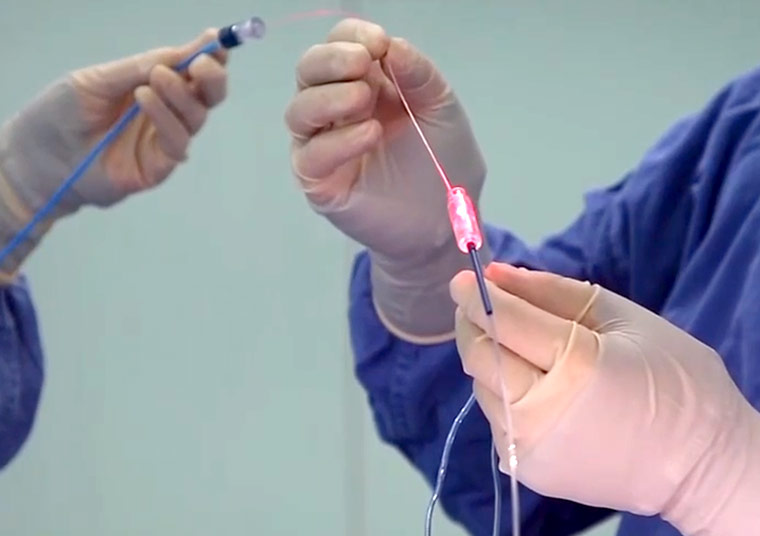
Laser ablation is a minimally invasive precise treatment technology that uses laser as an energy carrier, delivering energy precisely into the target tissue through a fine optical fiber, and achieving tissue inactivation through photothermal effects or selective photothermal action. This technology has core advantages such as confined thermal fields, controllable margins, and minimal damage to surrounding tissues, and has been widely applied in tumor treatment and functional neurosurgery.
The laser is transmitted through an optical fiber to the target tissue, where it is absorbed and converted into thermal energy, resulting in protein denaturation and coagulation, as well as cellular necrosis. Modern laser ablation systems are equipped with real-time MRI or CT temperature monitoring, allowing dynamic adjustment of energy output to ensure that the ablation range is precisely controlled within the lesion boundaries, with an error controllable within 1--2 mm.
Working Principle / Mechanism
Laser ablation mainly exerts its effect through the thermal effect:
Laser energy release
The laser fiber emits a high-energy beam.
Tissue absorption of energy
After absorbing the laser energy, the tumor tissue rapidly increases in temperature.
High temperature destroys cells
When the temperature reaches approximately above 60°C, tumor cell proteins undergo denaturation, and the cellular structure is destroyed.
Formation of coagulative necrosis
The tumor tissue undergoes irreversible necrosis and is gradually absorbed by the body or undergoes fibrosis.
Treatment Procedure
1. Preoperative assessment
The physician evaluates the size, location, and number of tumors through imaging examinations (CT, MRI, ultrasound, etc.) and formulates a treatment plan.
2. Anesthesia and localization
Local anesthesia or mild sedation is usually used, and the tumor is precisely localized under imaging guidance.
3. Fiber insertion
A fine laser fiber is inserted into the tumor through percutaneous puncture.
4. Laser ablation treatment
The laser system is activated to release energy for thermal ablation of the tumor.
5. Postoperative observation
After completion of treatment, imaging evaluation is performed, followed by short-term observation.
Safety and Precautions
1. Safety
Laser ablation is a mature minimally invasive technique performed under strict imaging guidance, with a high level of safety.
2. Possible reactions
Mild pain
Transient fever
Local swelling or discomfort
3. Postoperative precautions
Regular imaging follow-up according to medical advice
Avoidance of strenuous activity
Attention to puncture site care
Timely medical consultation in case of obvious discomfort
Cooperation with the physician for subsequent treatment or rehabilitation management
Frequently Asked Questions
1. Can laser ablation completely cure cancer?
For early-stage or small-volume tumors, laser ablation may achieve a local control effect comparable to surgery. However, the specific efficacy depends on the tumor type, size, and the overall condition of the patient.
2. How long is hospitalization required for treatment?
The hospital stay is generally short, and some patients can be discharged within 1--3 days after the procedure.
3. Is the treatment painful?
The treatment is usually performed under local anesthesia or sedation, and most patients experience only mild discomfort.
4. Can it be combined with other treatments?
Yes. Laser ablation is often combined with chemotherapy, targeted therapy, immunotherapy, and other modalities to improve the overall treatment effect.
5. Can treatment be repeated in case of tumor recurrence?
If conditions permit, laser ablation or other minimally invasive treatments can be performed again.
 + 86 17688273501
 Address
 Email Form
 Language
 English

 Hotline Phone+ 86 17688273501

 Back to Menu