Indications
① Applicable situations
• Deep-seated tumors or lesions in complex anatomical locations: lesions difficult to cover with conventional thermal ablation or with complex target morphology;
• Lesions with rich blood supply or requiring precise temperature control: situations needing enhanced local inactivation and boundary control;
• Tumors adjacent to major blood vessels or organs: requiring local control while preserving function;
• Patients unable to tolerate surgery or with postoperative recurrence: used as part of repeat local treatment or combined therapy;
• Patients seeking minimal trauma and faster recovery: individuals with high demands on quality of life, requiring a minimally invasive approach.
② Common indications
• Renal tumors
• Prostate tumors
• Bone and soft tissue tumors
• Deep or multiple liver tumors
• Deep lung lesions or those near blood vessels
• Other structurally complex or difficult-to-localize solid tumors
Core Advantages
① Dual physical inactivation through alternating cold and heat
Alternating cycles of extreme cold and heat cause tumor cells to undergo more thorough physical destruction, providing enhanced local control strategies for deep or complex lesions.
② Enhanced local blood supply--related damage, improving controllability
Cold and heat stimulation exacerbates damage to local microvascular endothelium and perfusion, promoting ischemic necrosis in the target area and expanding treatment strategy options for highly vascular lesions.
③ Suitable for deep and complex lesion operations
For lesions adjacent to major vessels, bony structures, or deep organs, precise path planning and range control under image guidance improve operability.
④ Minimally invasive, comfortable, and repeatable
Ultrafine probes are inserted percutaneously, resulting in small puncture wounds and fast recovery; the entire procedure uses physical energy without ionizing radiation or chemical toxicity, and can be repeated under appropriate conditions.
⑤ More flexible tract management
During alternating cold--heat cycles, tract management during the heating phase helps reduce tract bleeding and optimize local treatment outcomes.
⑥ Immune activation effect
The procedure can stimulate the body's immune response, aiding in the clearance of residual tumor cells, reducing recurrence risk, and further improving treatment safety and efficacy.
Why Choose Jinshazhou Hospital?
Our hospital relies on a multidisciplinary platform and has established a standardized system covering precise imaging assessment, minimally invasive local treatment, and coordinated comprehensive therapy plans. We have accumulated extensive clinical experience with the Kangbo Ablation system, treating hundreds of patients, and can design more precise access routes, cycle parameters, and safety boundary control strategies based on tumor location, vascular characteristics, and proximity to critical structures.
Within the MDT framework, the Kangbo system can be used in conjunction with radiotherapy, chemotherapy, interventional procedures, and systemic therapies, providing a more targeted minimally invasive treatment option for patients with deep, structurally complex, or recurrent tumors.
Technical Definition
Kangbo Alternating Cold--Hot Ablation is a multimodal local ablation technique. Using an ultrafine composite probe under imaging guidance, the probe is precisely inserted into the tumor, and alternating "ultra-low-temperature freezing + high-temperature heating" is applied to achieve dual physical inactivation of the target tissue.
This technique emphasizes precise control of the ablation zone and requires only a small puncture. It is suitable for certain deep, structurally complex, or highly vascularized lesions, providing a local control solution while prioritizing safety margins and preservation of organ function.
Mechanism of Action / Working Principle
Under CT or ultrasound guidance, an ultrafine composite Kangbo probe (approximately 2 mm) is percutaneously inserted into the targeted tumor area. Multiple alternating cycles of cold and heat are applied according to preset parameters: during the freezing phase, intracellular and extracellular ice crystals form, disrupting cellular structures and affecting local microcirculation; the subsequent heating phase denatures proteins, further enhancing tissue injury, and can also be used to manage the puncture tract. After several cold--heat cycles, the targeted tissue undergoes irreversible changes, achieving local tumor inactivation and control.
Treatment Procedure
① Preoperative Assessment: Use imaging to determine lesion location, size, and relationship with blood vessels/organs; evaluate baseline status including coagulation and cardiopulmonary function.
② Treatment Planning: Determine access route, number/position of probes, cold--heat cycle parameters, and any combined therapy strategies if needed.
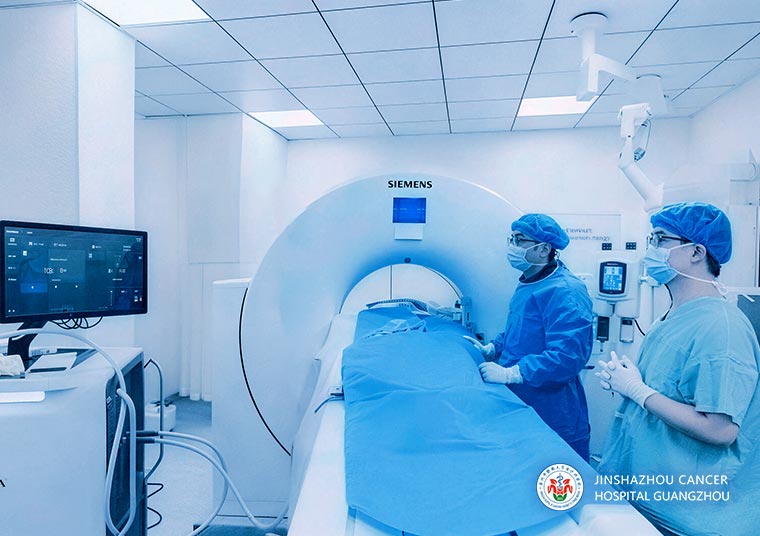
③ Probe Insertion under Imaging Guidance: Precisely place the composite probe into the target area using real-time CT or ultrasound guidance.
④ Alternating Cold--Heat Ablation: Perform multiple planned cold--heat cycles while monitoring the treatment area in real time.
⑤ Tract Management and Probe Removal: Manage the puncture tract and remove the probe after completing ablation of the target area.
⑥ Postoperative Observation and Follow-up: Monitor vital signs and local reactions in the short term; evaluate efficacy and check for recurrence with enhanced CT/MRI during follow-up.
Safety and Precautions
Kangbo combined cold--hot ablation, when performed under strict adherence to procedural standards and appropriate indications, is a safe and effective tumor treatment, particularly suitable for patients who cannot undergo surgery or prefer to avoid conventional treatments. However, the specific treatment plan should be determined by a qualified physician based on the individual patient's condition.
After Kangbo combined cold--hot ablation, patients should pay attention to the following: keep the puncture site clean and dry; follow medical advice for follow-up to monitor treatment effectiveness and tumor changes; avoid strenuous exercise and heavy physical labor in the short term; and seek medical attention promptly if unusual symptoms occur, such as persistent high fever, significant bleeding or swelling, difficulty breathing, or severe pain.
Frequently Asked Questions
① Is Kangbo combined extreme temperature ablation considered a "special surgery"?
It is a minimally invasive local ablation performed under imaging guidance. The treatment is typically carried out by percutaneously inserting the probe into the tumor target area. Unlike surgical resection, the tumor tissue is not removed; instead, the lesion is inactivated in situ and later gradually absorbed or stabilized as scar tissue by the body. Treatment efficacy is mainly evaluated through imaging follow-up.
② Will Kangbo combined extreme temperature ablation affect daily life?
Kangbo combined extreme temperature ablation is minimally invasive and has a rapid recovery. Most patients can get out of bed the same day after treatment, with minimal impact on daily life. Post-treatment, wound care is necessary, and strenuous exercise or heavy physical labor should be avoided. Recovery time may vary depending on the individual.
Typical Case
Patient: Male, 76 years old
Long-term smoker with underlying pulmonary conditions including chronic obstructive pulmonary disease, interstitial pneumonia, emphysema, and pulmonary bullae.
Diagnosis: Presented with a mass in the right upper lung. Percutaneous biopsy was performed, and pathology with immunohistochemistry indicated poorly differentiated large cell lung carcinoma (advanced stage).
Treatment plan: Considering the patient's limited cardiopulmonary reserve, he was not suitable for thoracic surgical resection, and had limited tolerance to conventional chemotherapy and other systemic treatments. Our team opted for Kangbo combined extreme temperature ablation to reduce tumor burden and optimize conditions for subsequent comprehensive therapy.
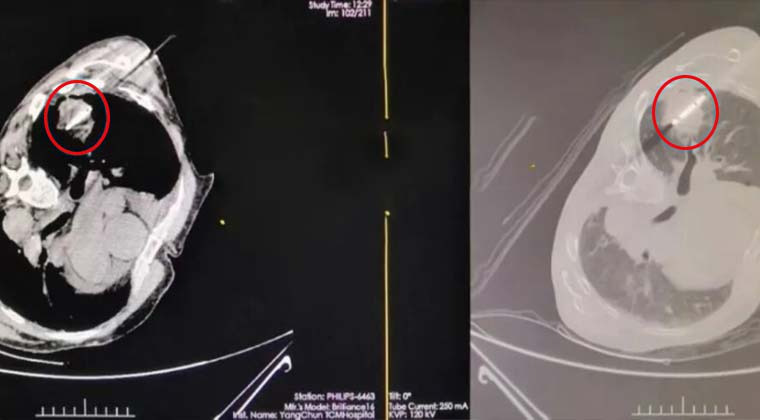
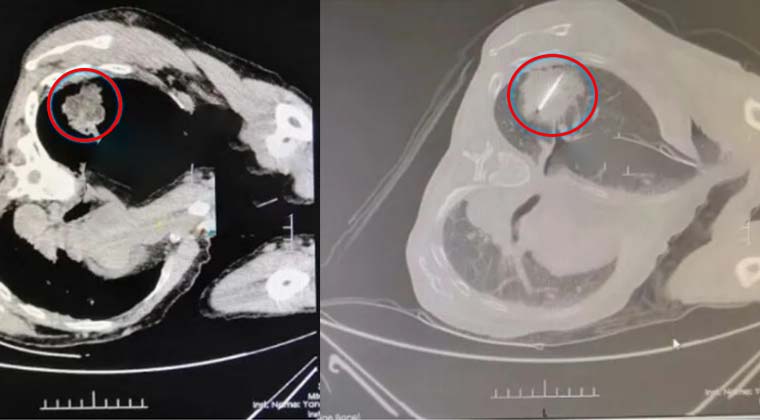
Treatment and initial results: Kangbo combined extreme temperature ablation was performed under imaging guidance. Post-treatment imaging showed a reduction in tumor size and tumor burden, creating favorable conditions for further comprehensive therapy and ongoing management.
Kangbo probe is precisely inserted into the tumor tissue under real-time CT guidance.
After two extreme temperature cycles, most of the tumor tissue has been ablated and become necrotic. Ice crystals fully cover the edges of the lung cancer mass.
 + 86 17688273501
 Address
 Email Form
 Language
 English

 Hotline Phone+ 86 17688273501

 Back to Menu