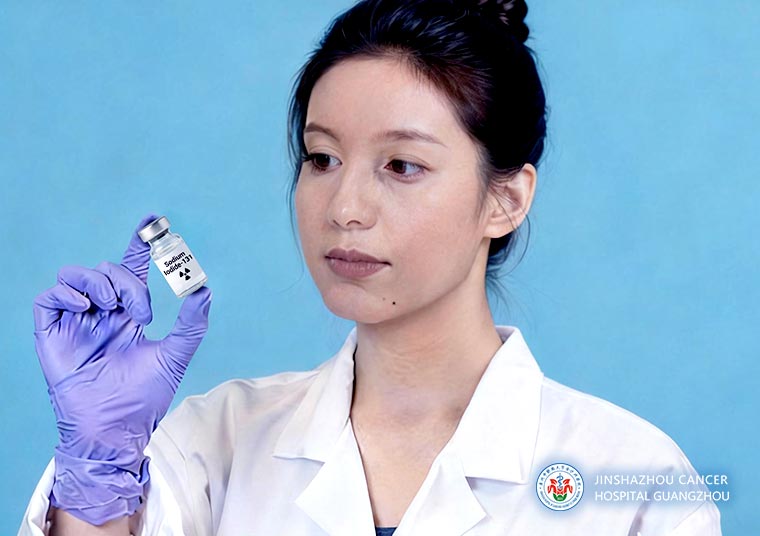
Iodine-131 radionuclide internal irradiation therapy
Keywords: Iodine-131 therapy, radioiodine therapy, thyroid cancer, hyperthyroidism, radionuclide internal irradiation, targeted therapy, radionuclide
Abstract: Radioiodine therapy is an orally administered treatment in which radioactive iodine (I-131) is delivered in gelatin capsules. It exploits the thyroid tissue's natural ability to uptake iodine for targeted irradiation. It is mainly used as adjuvant therapy after thyroid cancer surgery and for non-surgical treatment of hyperthyroidism, achieving precise and minimally invasive local control.
Indications
Iodine-131 radionuclide internal therapy is mainly used for thyroid tissue or related lesions that retain the ability to uptake iodine. Clinically, its common applications are divided into two categories:
① Thyroid cancer: Primarily for iodine-avid papillary or follicular carcinomas. It is mainly used for further management after surgery or in cases of recurrence/metastasis, such as:
• Removal of residual thyroid tissue after surgery.
• Treatment of recurrent or metastatic lesions that uptake iodine.
② Hyperthyroidism: Such as Graves' disease, toxic multinodular goiter, and toxic adenoma. It is more commonly used in patients who:
• Seek more stable control of thyroid function and wish to reduce frequent medication adjustments.
• Are unsuitable for or unwilling to undergo surgery.
• Have chronic conditions such as heart disease or liver disease, requiring careful consideration of treatment options.
• Have a visibly enlarged thyroid and hope to control thyroid function while improving goiter.
• Have experienced adverse reactions to antithyroid drugs or had unsatisfactory treatment outcomes.
• Relapse after discontinuing medication or after prior surgery.
Key Advantages
① Strong targeting, more focused treatment: Iodine-131 is selectively absorbed by thyroid tissue or related lesions with the ability to take up iodine, delivering a local radiation dose. This achieves directed irradiation while minimizing impact on other tissues.
② Continuous effect as an internal radiation therapy: As an internal source of radiation, iodine-131 accumulates in the target tissue and gradually releases energy over time, providing a more concentrated and continuous therapeutic effect.
③ Relatively simple administration: In most cases, the treatment is given orally, without surgical incisions or repeated punctures, which improves patient compliance and reduces overall burden.
④ Imaging and monitoring for follow-up: After treatment, nuclear imaging such as SPECT can track the distribution and uptake of radioactive iodine, providing a basis for evaluating efficacy, planning follow-up, and managing further care.
⑤ Long history, rich experience, and mature protocols: Iodine-131 has a long clinical history worldwide, with extensive accumulated experience. Established evaluation, management, and follow-up systems help make the treatment process more standardized and controllable.
Why choose Jinshazhou Hospital?
Our hospital provides I-131 radionuclide therapy, following a standardized pathway grounded in nuclear medicine assessment, ensuring clear treatment objectives, controllable implementation, and traceable follow-up. When necessary, multidisciplinary collaboration coordinates with surgical and pharmacological therapies. Patients can complete the entire care process---from evaluation and examination to treatment and follow-up---within a single center, offering a more coherent workflow, smoother communication, and reduced travel and waiting times.
In the management of thyroid cancer, I-131 often serves as a key postoperative step. We adhere to the internationally accepted integrated approach, maintaining a long-term three-step protocol: surgery, TSH suppression therapy, and I-131 treatment. After surgical removal of the primary lesion, TSH suppression is applied through thyroid hormone therapy. Based on examination results and lesion characteristics, postoperative I-131 therapy may be administered to address residual thyroid tissue or iodine-avid lesions, helping to reduce the risk of recurrence.
Furthermore, our imaging platform is comprehensive, equipped with PET/CT, PET/MRI, and SPECT/CT nuclear medicine devices. SPECT/CT fusion imaging is used to evaluate lesion distribution and iodine uptake characteristics, enabling individualized dosing and management plans. A dedicated radionuclide therapy ward is available, where patient education and isolation monitoring are conducted under strict radiation protection requirements, and clear, actionable discharge instructions and follow-up guidance are provided.
For overseas patients, we prioritize the feasibility and continuity of care. A dedicated team manages the entire process of seeking treatment in China, leveraging mature coordination mechanisms and standardized workflows to provide patients with a more stable and reliable care experience.
Technical Definition
Iodine‑131 radionuclide internal radiation therapy is a treatment method in which radioactive iodine‑131 is administered orally in the form of a medication (capsule or oral solution). Taking advantage of its ability to accumulate in thyroid tissue and related lesions with iodine‑uptake capacity, it locally releases therapeutic energy to achieve targeted internal irradiation within the body.
Mechanism / Working Principle
① Oral administration and targeted accumulation: After oral intake, I-131 enters the bloodstream, and cells with iodine uptake ability actively absorb and store iodine, allowing the radioactive iodine to concentrate more effectively in the relevant tissue or iodine-avid lesions.
② β radiation reduces thyroid function (hyperthyroidism): Once I-131 accumulates in thyroid tissue, it releases predominantly β radiation over a short range, gradually decreasing the activity of overactive thyroid cells, thereby improving hyperthyroidism.
③ β radiation treats iodine-avid residual tissue or lesions (post-thyroid cancer surgery): If residual thyroid tissue or related lesions are iodine-avid, I-131 locally releases β radiation, causing cellular damage and gradually inhibiting cell proliferation, which reduces lesion activity and burden.
④ γ radiation assists imaging evaluation: During decay, I-131 emits γ radiation, which can be detected by external nuclear medicine devices. SPECT imaging allows visualization of the distribution and uptake of I-131 in the body.
Treatment Process
I-131 therapy in clinical practice generally follows two pathways: treatment of hyperthyroidism and post-operative management of thyroid cancer. Specific steps may vary depending on the patient's condition and institutional protocols. The main workflow is as follows:
① Evaluation and plan formulation: Physicians order necessary tests and explain preparation requirements. Based on medical history, test results, and individual risks, they determine whether I-131 is appropriate, define treatment goals, and decide on isolation management if needed. Patients complete required tests as instructed and provide accurate information regarding pregnancy, lactation, and prior medications.
② Pre-treatment preparation: Patients follow dietary and medication adjustments according to instructions. Medical staff provide essential education and reminders (e.g., contraindications related to pregnancy or lactation, medication adjustments, and post-treatment safety measures) to ensure safe therapy implementation.
③ Oral administration: Before dosing, medical staff complete patient education and verification. Patients take I-131 orally as prescribed.
④ Observation and management: Depending on dose and radiation protection requirements, patients undergo brief inpatient observation or short-term isolation to minimize unnecessary contact with others, while following personal hygiene and excretion safety rules.
⑤ Discharge instructions: Medical staff provide guidance on post-discharge radiation safety (e.g., personal hygiene, distancing, water intake, and excretion handling) and schedule follow-up tests. Patients are instructed on how to seek medical advice if abnormal symptoms occur and to follow daily protection and follow-up plans.
⑥ Follow-up and review: Patients return for scheduled follow-up. Physicians assess treatment response based on results and adjust further management: for hyperthyroidism, follow-up focuses on thyroid function and medication adjustment; for post-thyroid cancer patients, follow-up typically includes nuclear medicine evaluation and long-term monitoring.
Frequently Asked Questions
① Is hospitalization required for I-131 treatment? How many days are usually needed?
Answer: Not necessarily. Hospitalization depends mainly on the treatment purpose, the administered dose, and radiation safety requirements. Low-dose treatments may be completed on an outpatient basis; if isolation is required, the typical duration is 3--5 days, occasionally longer, depending on internal radiation levels and the physician's assessment.
② What precautions should be taken after treatment to minimize the impact on family members?
Answer: Drink plenty of water and urinate frequently; maintain toilet hygiene and personal hygiene; initially after discharge, minimize prolonged close contact with others, especially pregnant women and infants/children; wash or handle clothing and personal items according to medical guidance. Follow the instructions provided by healthcare staff for specific measures.
③ What discomfort or side effects may occur?
Answer: A small number of patients may experience short-term nausea, dry mouth, taste changes, neck discomfort, or swelling, which are usually manageable with symptomatic treatment. If persistent or severe discomfort, fever, or significant swelling/pain occurs, contact your physician promptly.
④ Can I become pregnant or have children after treatment? How long should contraception be used?
Answer: In most cases, I-131 treatment does not affect future fertility. For safety, it is generally recommended to avoid pregnancy for 6 months to 1 year after treatment, waiting until follow-up shows stable thyroid function and hormone levels before planning conception. Specific guidance should follow the physician's assessment.
Typical Cases
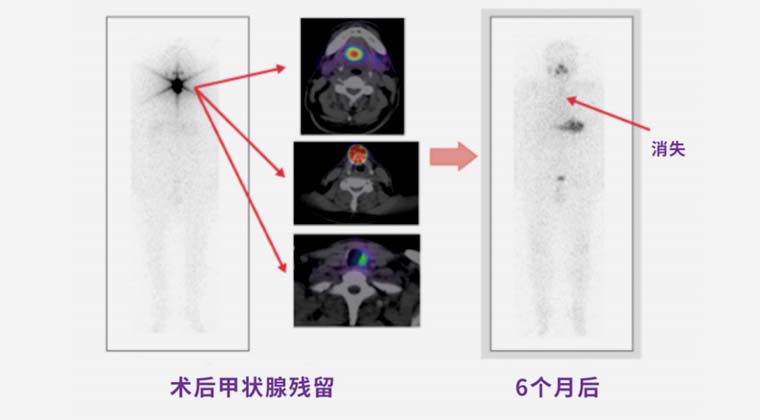
① Case 1:
Thyroid cancer – Postoperative remnant ablation to remove residual thyroid tissue:
Postoperative thyroid remnant
6 months later
Remnant disappeared
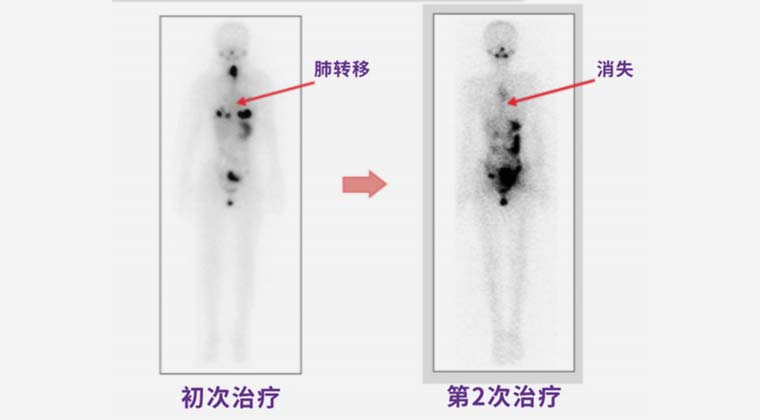
② Case 2:
Patient: Female, 24 years old – Follicular thyroid cancer – Treatment of distant metastases of thyroid cancer:
First treatment – Lung metastases
Second treatment – Metastases disappeared
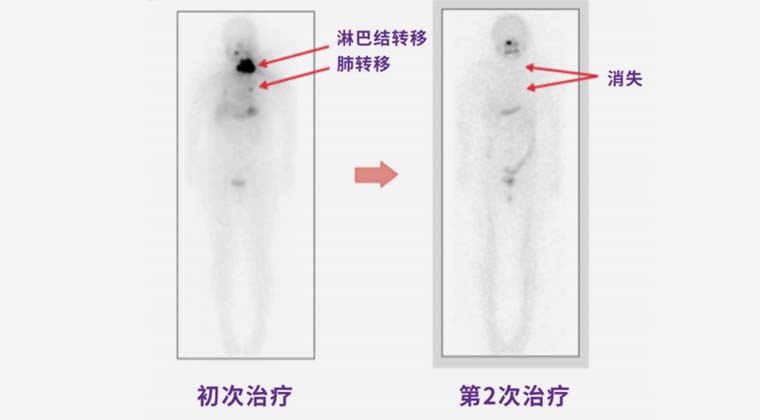
③ Case 3:
Patient: Female, 46 years old – Papillary thyroid cancer – Treatment of distant metastases of thyroid cancer:
First treatment – Lymph node metastases, Lung metastases
Second treatment – Metastases disappeared
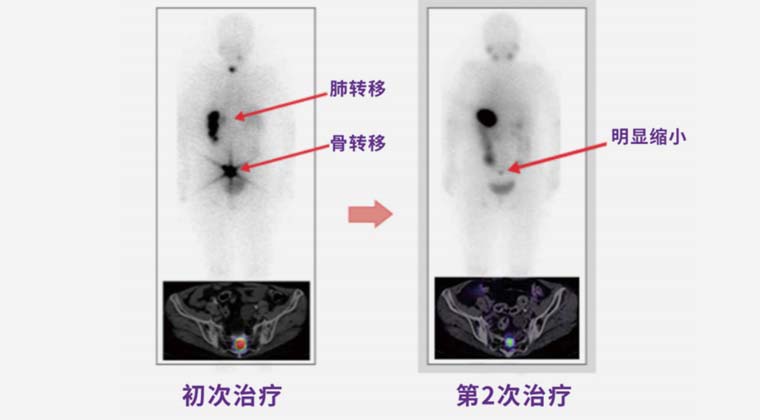
④ Case 4:
Patient: Male, 70 years old – Follicular thyroid cancer – Treatment of distant metastases of thyroid cancer:
First treatment – Lung metastases, Bone metastases
Second treatment – Metastases significantly reduced
 + 86 17688273501
 Address
 Email Form
 Language
 English

 Hotline Phone+ 86 17688273501

 Back to Menu