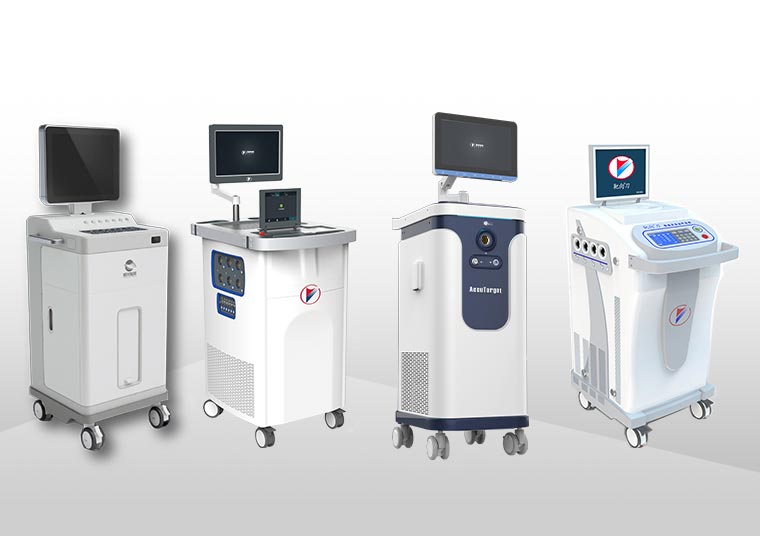
Cryoablation System: A more flexible minimally invasive option for local lesions
When dealing with local lesions, treatment is not limited to traditional open surgery. Cryoablation is a minimally invasive local treatment performed under imaging guidance. Under CT or ultrasound guidance, the physician accurately places the ablation probe into the target area and applies extremely low temperatures to treat the lesion.
1. Applicable to multiple common clinical scenarios, enabling more targeted local treatment
The cryoablation system at Jinshazhou Hospital of Guangzhou University of Chinese Medicine is primarily used for the minimally invasive local treatment of solid tumors in the lung, liver, kidney, prostate, bone, and breast. In addition to tumors, it can also be applied in certain benign conditions and symptom relief scenarios, such as selected benign breast lesions, benign prostatic hyperplasia, hepatic hemangioma, and cancer-related pain relief.
For patients with local recurrence, residual lesions, those not suitable for surgery for the time being, or those wishing to minimize trauma, this technology provides an alternative local treatment option beyond conventional open surgery.
2. More flexible equipment configuration, allowing treatment plans to better match the condition
The advantage of cryoablation at our hospital lies not only in a single device but in flexible equipment configurations. For example, targeted systems using nitrogen and argon-helium systems that use argon for cooling and helium for heating. The difference among these systems is not about which is more "advanced," but about enabling physicians to select more suitable tools based on lesion location, puncture pathway, pain sensitivity, and surrounding anatomical relationships.
Such configurations support more refined local treatment planning, allowing the treatment plan to better align with the actual condition rather than requiring patients to adapt to a fixed model.
3. More intuitive ice ball boundary, enabling clearer assessment of the treatment range
Our cryoablation system allows precise control of the ablation area. Under imaging guidance (such as CT or ultrasound), the ice ball can be clearly visualized. Physicians can more accurately assess the treatment range, boundary changes, and the relationship with surrounding critical structures, and adjust probe positioning and coverage in real time based on imaging feedback.
This helps reduce the risk of insufficient or excessive ablation, minimizes unnecessary impact on surrounding tissues, and improves the controllability and safety of local treatment.
4. More flexible probe configuration, enabling treatment tailored to lesion characteristics
In cryoablation procedures, the ablation probes are the instruments that directly perform treatment within the body. Our system provides disposable cryoablation probes of various specifications and designs, including different diameters, lengths, active tip lengths, and shapes such as straight, curved, sharp-tip, and blunt-tip designs.
Probe design also considers insulation and tract protection, for example through high-vacuum insulation technology, which helps balance effective local treatment with protection of surrounding tissues during insertion.
Physicians can select appropriate probes based on lesion location, depth, size, and adjacent anatomy. For larger or irregularly shaped lesions, multi-probe combinations can be used for conformal treatment. Choosing suitable probes helps ensure adequate lesion coverage while minimizing puncture-related trauma, reducing additional tissue injury, and supporting postoperative recovery, wound appearance, and overall patient burden.
For patients, this means treatment is not a one-size-fits-all approach, but is carefully tailored based on lesion characteristics.
5. More comprehensive integrated care, helping patients avoid unnecessary detours
The value of cryoablation at Jinshazhou Hospital of Guangzhou University of Chinese Medicine lies not only in completing a local procedure, but also in its integration into a comprehensive care pathway. Our hospital has capabilities in imaging guidance, minimally invasive intervention, multidisciplinary evaluation, and coordination of subsequent treatments.
Based on individual patient conditions, cryoablation can be combined with surgery, radiotherapy, pharmacological treatment, and other interventional approaches. From examination and evaluation to treatment planning, implementation, and follow-up, a more streamlined clinical pathway is established.
For patients, this not only provides an additional minimally invasive option, but also ensures that treatment is planned based on lesion location, surrounding anatomical relationships, and overall therapeutic strategy.
 + 86 17688273501
 Address
 Email Form
 Language
 English

 Hotline Phone+ 86 17688273501

 Back to Menu